
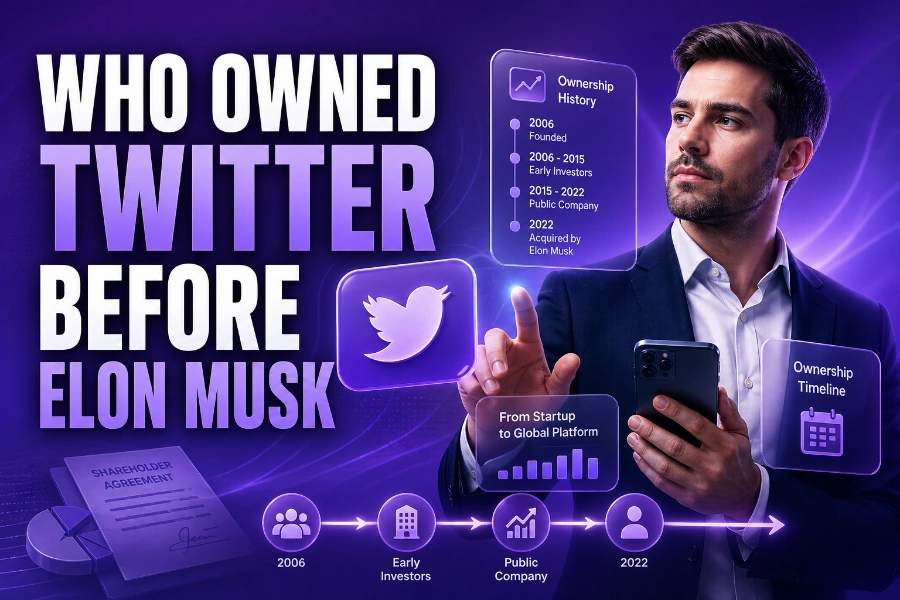
The question “Who owned Twitter before Elon Musk?” is an interesting one that reveals the evolution of a social media giant. Understanding Twitter’s ownership history not only sheds light on the platform’s growth but also provides insights into its future post-Musk era.
From its creation in 2006 to Musk’s acquisition in 2022, several major figures and institutional investors have played a pivotal role in shaping Twitter’s trajectory. Let’s delve into Twitter’s ownership timeline and understand how it transformed over the years.
Twitter’s Founding and Early Days of Ownership
Twitter was founded by Jack Dorsey, Biz Stone, and Evan Williams in 2006, with Noah Glass playing a crucial role in its early development. These founders held the company’s initial ownership stakes. However, as Twitter grew in popularity, the founders sought investments from venture capitalists. This is where the first institutional investors began to play a role in the company’s growth.
In the early stages, Twitter’s ownership was relatively straightforward, with the key figures being Dorsey, Williams, and Stone. But over time, the company attracted significant investment, diluting its stake. This period marked the start of a series of changes that would eventually lead to institutional investors and private equity firms holding substantial shares in Twitter.
As Twitter expanded, major institutional players like Vanguard Group, Morgan Stanley, and others began acquiring significant stakes. These investors helped shape the company, pushing it towards its eventual listing on the New York Stock Exchange (NYSE) in 2013. As Twitter transitioned to a public company, its ownership structure diversified further, with large institutional investors holding influential stakes. To view Twitter’s ownership progression and how these changes have impacted the company, use tools like the Twitter account viewer to track public data on its major stakeholders.
Major Stakeholders Before Elon Musk’s Acquisition
Before Elon Musk’s acquisition of Twitter in 2022, the company’s ownership had become a complex web of institutional investors, corporate executives, and employees. The largest shareholders of Twitter before Musk were significant financial institutions. Vanguard Group, a leading investment management firm, held the largest share of 10.3%, followed closely by Musk himself, who owned approximately 9.2% of the company. Additionally, Morgan Stanley and other institutional investors held substantial stakes in Twitter’s stock.
Despite these large shareholders, Jack Dorsey, the co-founder and former CEO of Twitter, remained involved in the company. However, his influence had diminished over time, and by the time of Musk’s acquisition, he held only about 2.4% of Twitter’s stock. This shift reflected a broader trend in which large institutional investors took a more active role in Twitter’s decision-making.
The ownership structure at this point meant that Twitter was heavily influenced by large financial institutions, which made decisions based on stock performance and long-term returns. As the public company continued to grow, it became more corporate in nature, with many decisions focused on maximizing shareholder value. However, as we moved into Musk’s 2022 acquisition, these institutional owners were not ready to let go easily, leading to a complex negotiation process. For those interested in the dynamics of Twitter’s ownership at that time, tools like the Twitter post viewer can help in tracking tweets from key stakeholders.
Twitter’s Transition to Public Ownership
In 2013, Twitter made a significant move by becoming a publicly traded company, listing its shares on the New York Stock Exchange (NYSE) under the ticker symbol TWTR. This was a pivotal moment in Twitter’s history, as it shifted from a private entity to a publicly traded company. The initial public offering (IPO) brought significant changes to Twitter’s ownership structure, enabling institutional investors to buy and sell shares on the open market.
As a publicly traded company, Twitter’s ownership became more diverse, with stock ownership spread across thousands of institutional investors, retail investors, and employees. This made it difficult for any single shareholder to exert overwhelming influence over the company, but large institutional investors such as Vanguard Group, BlackRock, and Morgan Stanley held substantial stakes. Over time, these firms became some of the most influential players in Twitter’s corporate strategy.
Despite the diversification of ownership, Jack Dorsey, as the co-founder and long-time CEO of Twitter, remained an important figure in the company. He continued to push for a vision that would make Twitter a unique platform for free speech and global discourse. His tenure as CEO, however, was marked by constant battles with investors who wanted Twitter to focus more on profitability and less on its social mission.
The Role of Private Investors and Dorsey’s Influence
As Twitter evolved into a public company, it was not just institutional investors that had a significant stake in the company. Private investors, such as Elliott Management, began to assert influence over Twitter’s strategic decisions. In 2020, Elliott Management, an activist hedge fund, acquired a significant stake in Twitter, demanding changes in leadership and strategy.
This period marked a shift in Twitter’s ownership structure, where private investors had more say in the company’s future. This led to Jack Dorsey being replaced as CEO in 2021 by Parag Agrawal, although Dorsey remained on the board of directors. However, the influence of private investors continued to grow, setting the stage for Elon Musk’s eventual acquisition of Twitter.
While Musk’s 2022 acquisition of Twitter was a dramatic shift, it was the culmination of years of shareholder activism and internal changes. Musk’s offer to buy Twitter was driven by a belief that the platform needed a more hands-on, entrepreneurial approach. This was reflected in his move to buy the company for $44 billion, a deal that ultimately reshaped Twitter’s future.
Elon Musk’s Acquisition and What Changed
In April 2022, Elon Musk officially made an offer to buy Twitter, a deal that shocked the tech world. Musk’s purchase of Twitter was seen as a bold move to take control of a platform he felt was integral to public discourse, but which was also suffering from poor management and a lack of innovation. Musk’s involvement in Twitter marked a dramatic departure from the era of institutional ownership.
Once the acquisition was finalized in October 2022, Musk’s vision for Twitter became the company’s central focus. He immediately began implementing major changes to the platform, including layoffs and altering Twitter’s content moderation policies. Musk’s leadership also led to a significant change in Twitter’s business model, with a stronger emphasis on subscription services and advertising revenue.
Musk’s purchase of Twitter signaled the end of an era of institutional control and the beginning of a more individualistic, entrepreneur-driven approach to managing the company. For those who want to understand the shifting dynamics of Twitter’s ownership, the Twitter media viewer is an excellent tool for tracking the various changes Musk has made since the acquisition.
Conclusion
In conclusion, the history of Twitter’s ownership before Elon Musk reveals a journey from a small startup to a major global platform controlled by large institutional investors. These institutions, including Vanguard Group, Morgan Stanley, and others, played an instrumental role in shaping Twitter’s direction for years. However, Musk’s 2022 acquisition changed the narrative by placing the platform under the control of an individual entrepreneur. This transformation marks a significant turning point in Twitter’s history and raises questions about the future of social media companies and their governance structures.
Through the changes in ownership, Twitter has always remained at the heart of global communication. Whether it’s through its diverse ownership structure or the dramatic shifts introduced by Musk, Twitter continues to evolve. The public’s ability to view Twitter profiles and tweets provides valuable insight into how ownership has shaped the platform over time. As the company moves forward, it will be interesting to see how its management and ownership continue to evolve.
FAQs
Who Owned Twitter Before Elon Musk?
Who were the major stakeholders in Twitter before Elon Musk’s acquisition?
Before Elon Musk’s acquisition, the major stakeholders in Twitter included institutional investors like Vanguard Group (10.3%), Morgan Stanley (8.4%), and Musk himself (9.2%), with Jack Dorsey holding a smaller 2.4% stake.
What led to Elon Musk’s acquisition of Twitter?
Elon Musk’s acquisition of Twitter in 2022 was driven by his belief that the platform needed changes in leadership, content moderation, and business model, leading to his $44 billion offer and restructuring of the company.
How did Twitter’s ownership evolve over the years?
Initially founded by Jack Dorsey and his team in 2006, Twitter’s ownership evolved from private to public in 2013, with large institutional investors like Vanguard Group and Morgan Stanley holding significant shares.
Was Jack Dorsey involved in Twitter’s ownership before Elon Musk took over?
Yes, Jack Dorsey, as Twitter’s co-founder and long-time CEO, held a 2.4% stake in the company before Musk’s acquisition, although his influence had diminished over time due to institutional investors taking larger stakes.
What role did institutional investors play in Twitter’s ownership?
Institutional investors like Vanguard Group and Morgan Stanley played a significant role in Twitter’s ownership, especially after its IPO in 2013, where they held substantial shares and influenced decisions with their large stakes.
How did Twitter’s IPO affect its ownership structure?
Twitter’s IPO in 2013 expanded its ownership to the public, diversifying it into thousands of individual and institutional investors, with Vanguard and other firms becoming some of the largest stakeholders, making it less founder-controlled.
Did private investors have an impact on Twitter’s ownership?
Yes, private investors, including activist hedge funds like Elliott Management, had an impact on Twitter’s ownership by pushing for leadership changes and greater profitability, ultimately influencing the company’s strategic decisions before Musk’s acquisition.
How did Musk’s ownership affect Twitter’s business model?
After Musk’s acquisition, Twitter’s business model shifted towards a focus on subscription services, advertising, and user-generated content. He introduced significant changes, including layoffs, new content moderation policies, and a restructuring of the company’s operations.
What was the role of Jack Dorsey in Twitter after the IPO?
After Twitter’s IPO, Jack Dorsey remained involved as CEO and later as a board member, although his role diminished over time as institutional investors took control and as he focused on other ventures, including Square.
How did the public view the changes made by Elon Musk?
The public had mixed reactions to Elon Musk’s changes at Twitter, with some praising his vision for a more open platform and others criticizing the layoffs and policy shifts. His takeover significantly reshaped the platform’s direction.